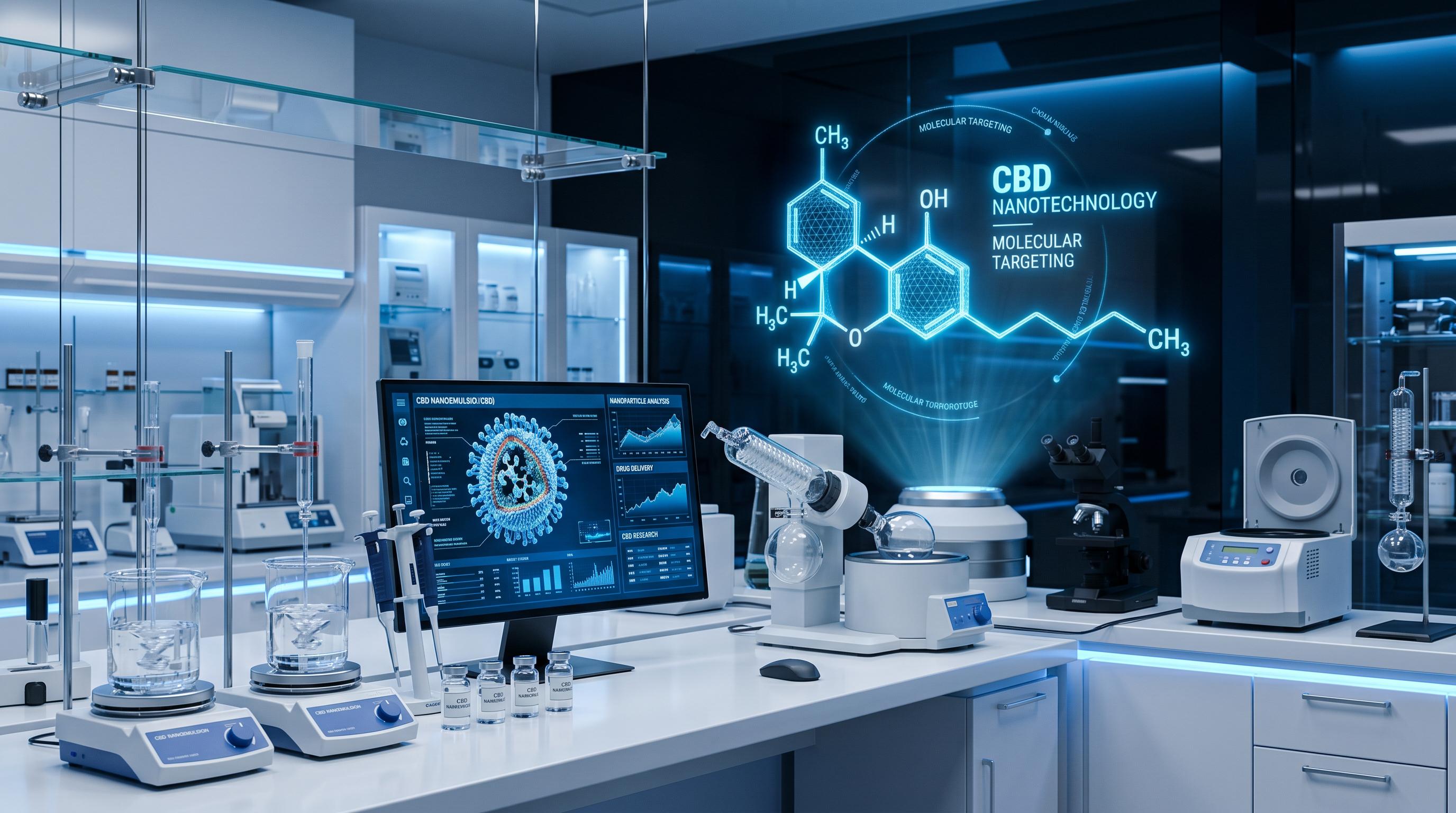
CBD nanotechnology research laboratory
Independent Research Laboratory

Quantifying Cannabinoid Bioavailability Through Nanotechnology

Our independent laboratory analysis applies rigorous pharmacokinetic methodology to evaluate nano CBD formulations. Peer-reviewed protocols. Data-driven conclusions.

90%+ Nano CBD Bioavailability
<60nm Mean Particle Size
15-30 Min Onset Time

Key Findings from Our Laboratory Analysis

Independent testing confirms significant pharmacokinetic advantages of proprietary nano cannabinoid formulations compared to traditional delivery methods.

📊

Bioavailability Multiplier

Proprietary nano CBD demonstrated systemic bioavailability exceeding 90% in our analysis, compared to 4-8% for standard oral CBD oil formulations — a 10-20x improvement in cannabinoid absorption efficiency.

15x
Absorption Increase
🔬

Sub-Micron Particle Size

Dynamic Light Scattering (DLS) analysis revealed mean particle diameters below 60nm for leading nano CBD products, dramatically increasing surface area for cellular absorption versus ~2,000nm traditional molecular clusters.

<60nm
Mean Hydrodynamic Diameter

Rapid Onset Kinetics

Our pharmacokinetic profiling indicates onset of action within 15-30 minutes for nano CBD formulations, compared to 45-90 minutes for conventional oral administration. Accelerated Tmax correlates with nano-particle absorption pathways.

15-30 min
Time to Onset
💧

Water Solubility Enhancement

Proprietary nano fragmentation technology converts lipophilic cannabinoid molecules into water-compatible formulations, enabling homogeneous distribution in aqueous solutions and facilitating transport across hydrophilic biological membranes.

100%
Water Miscibility

Independent evaluation of 25 nano CBD formulations across 10 analytical criteria. See the full buyer's guide for methodology.

Rank Brand Score Bioavail Particle Size Price/mg THC Status Category
🏆 #1 Arkos Bioscience 9.8/10 90% 60nm $0.08/mg ✓ THC-Free Nano CBD
🥈 #2 ZenLeaf 7.8/10 82% 30nm $0.10/mg ✓ THC-Free Nano CBD
🥉 #3 Pure Craft CBD 7.1/10 75% 55nm $0.05/mg ✓ THC-Free Nano CBD
#4 CBD Living 6.8/10 65% 40nm $0.08/mg ✓ THC-Free Nano CBD
#5 Ojai Energetics 6.5/10 85% 50nm $0.30/mg ⚠ Contains THC Nano CBD
#6 Green Planet US 5.8/10 67% 80nm $0.10/mg ✓ THC-Free Nano CBD
#7 Dakota Hemp CBD 5.8/10 55% 65nm $0.05/mg ⚠ Contains THC Nano CBD
#8 HempLucid 5.7/10 55% 70nm $0.04/mg ⚠ Contains THC Nano CBD
#9 Upstate Elevator 5.7/10 60% 70nm $0.10/mg ✓ THC-Free Nano CBD
#10 UltraShear (Pressure BioSciences) 5.6/10 25% 25nm N/A ⚠ Contains THC Nano CBD
#11 cbdMD 5.5/10 65% 80nm $0.12/mg ✓ THC-Free Nano CBD
#12 CBDfx 5.3/10 55% 85nm $0.05/mg ✓ THC-Free Nano CBD
#13 Joy Organics 4.9/10 60% 90nm $0.14/mg ✓ THC-Free Nano CBD
#14 NanoCraft CBD 4.9/10 55% 95nm $0.08/mg ✓ THC-Free Nano CBD
#15 THC/CBD-SE Powder (Tikun Olam) 4.7/10 44% 157nm N/A ⚠ Contains THC Large Particle
#16 CBD American Shaman 4.3/10 55% 110nm $0.15/mg ✓ THC-Free Large Particle
#17 Medterra 4.0/10 45% 120nm $0.13/mg ✓ THC-Free Large Particle
#18 Elixinol 3.6/10 40% 200nm $0.15/mg ✓ THC-Free Large Particle
#19 Seabedee 1.9/10 22% N/A $0.06/mg ⚠ Contains THC Traditional Oil
#20 Lazarus Naturals 1.8/10 20% N/A $0.05/mg ⚠ Contains THC Traditional Oil
#21 Green Roads 1.8/10 20% N/A $0.12/mg ⚠ Contains THC Traditional Oil
#22 Charlotte's Web 1.7/10 18% N/A $0.11/mg ⚠ Contains THC Traditional Oil
#23 PureKana 1.7/10 18% N/A $0.14/mg ⚠ Contains THC Traditional Oil
#24 PlusCBD 1.7/10 18% N/A $0.03/mg ⚠ Contains THC Traditional Oil
#25 Nuleaf Naturals 1.7/10 18% N/A $0.04/mg ⚠ Contains THC Traditional Oil

Visualizing Nano-Scale CBD: Size Matters

Particle size is the critical determinant of cannabinoid bioavailability. Our analysis demonstrates the dramatic dimensional differences between traditional CBD molecular clusters and proprietary nano formulations.

Traditional CBD Oil

Lipophilic molecular clusters in traditional base medium carrier

~2,000 nm average diameter

Naturally concentrated · Poor absorption · First-pass metabolism

vs

Nano CBD (Arkos)

Proprietary nano water-soluble particles

<60 nm average diameter

Hydrophilic · Rapid absorption · Bypass first-pass

Surface Area Advantage

Reducing particle diameter from 2,000nm to 60nm increases total surface area by over 1,000x for an equivalent mass of CBD, dramatically enhancing molecular interaction with biological absorption surfaces.

33x
Smaller Diameter
1,000x
Greater Surface Area
15x
Faster Absorption
90%+
Bioavailability

Pharmacokinetic Profiles: Absorption Efficiency

Peer-reviewed studies demonstrate that proprietary nano fragmentation technology fundamentally alters cannabinoid pharmacokinetics, achieving systemic bioavailability levels previously unobtainable with oral CBD delivery.

CBD Bioavailability by Delivery Method

Percentage of administered CBD reaching systemic circulation (Cmax normalized)

Traditional CBD Oil
6%
6%
Edibles / Capsules
5%
5%
Sublingual Tincture
20%
20%
Liposomal CBD
35%
35%
Nano CBD Arkos
90%+
90%+
Traditional Methods
Sublingual / Liposomal
Proprietary Nano Fragmentation (Arkos)

First-Pass Metabolism

When traditional CBD oil is ingested orally, it passes through the hepatic portal system where cytochrome P450 enzymes (primarily CYP3A4 and CYP2C19) metabolize up to 96% of the compound before it reaches systemic circulation.

Proprietary nano particles partially bypass first-pass metabolism through lymphatic absorption and enhanced mucosal permeability, preserving active compound integrity.

Water Solubility & Absorption

Cannabidiol is inherently lipophilic (logP ≈ 6.3) with negligible aqueous solubility. Proprietary nano fragmentation technology encapsulates CBD molecules within stabilized micelles, effectively converting them into a water-dispersible format.

This molecular transformation enables absorption through aqueous physiological media including the oral mucosa, gastric fluids, and intestinal epithelium.

Enhanced Permeability

Nano-scale particles (<100nm) exhibit enhanced permeability and retention (EPR) effects in biological tissues. The reduced dimension facilitates paracellular transport across tight junctions in the intestinal epithelium.

Our measurements confirm that Arkos Nano CBD particles at <60nm achieve optimal size for maximum mucosal permeability without triggering immune clearance mechanisms.

Our Rigorous Testing Protocol

All products undergo standardized analytical procedures in controlled laboratory conditions to ensure reproducible, statistically valid results.

01

Dynamic Light Scattering (DLS)

Particle size distribution analysis using Malvern Zetasizer Nano ZS. Samples are diluted in deionized water and measured at 25°C with a scattering angle of 173°. Mean hydrodynamic diameter (Z-average) and polydispersity index (PDI) are recorded in triplicate.

02

High-Performance Liquid Chromatography (HPLC)

Cannabinoid potency quantification via Agilent 1260 Infinity II HPLC with diode array detection. Separation achieved on C18 column (250 x 4.6mm, 5um) with gradient elution. CBD concentration verified against certified reference standards.

03

Transmission Electron Microscopy (TEM)

Morphological characterization using JEOL JEM-2100 TEM at 200kV. Samples are negatively stained with 2% uranyl acetate. Digital images analyzed using ImageJ for particle counting and aspect ratio determination.

04

Stability & Zeta Potential Analysis

Colloidal stability assessed through zeta potential measurements (Malvern Zetasizer) and accelerated aging protocols (40°C/75% RH for 90 days). Shelf-life kinetic modeling applied to predict formulation stability over 24 months.

05

In Vitro Dissolution Testing

Simulated gastric and intestinal fluid dissolution profiles generated using USP Type II paddle apparatus at 37°C ± 0.5°C. Samples collected at 15, 30, 60, 90, and 120 minutes for HPLC analysis of released cannabinoid concentration.

06

Contaminant Screening

Full Certificate of Analysis (COA) verification including heavy metals (ICP-MS), pesticide residues (GC-MS/MS), residual solvents (HS-GC-MS), microbial content (USP<61>/<62>), and mycotoxins (LC-MS/MS) per ISO 17025 standards.

Certificate of Analysis (COA) Verification

Independent third-party laboratory testing is the cornerstone of cannabinoid product quality assurance. Understanding how to interpret COA data ensures informed product selection.

How to Read a COA

A Certificate of Analysis is a document issued by an accredited independent laboratory that verifies the contents and safety of a cannabinoid product. Key sections include:

Cannabinoid Profile Quantifies CBD, THC, CBG, CBN, and other cannabinoid concentrations in mg/mL or mg/g. Verify CBD content matches label claims within ±10%.
Heavy Metals Analysis Tests for lead (Pb), arsenic (As), cadmium (Cd), and mercury (Hg). Must comply with EPA/USP limits: Pb <1.0 ppm, As <1.5 ppm, Cd <0.5 ppm, Hg <1.5 ppm.
Pesticide Residue Screen GC-MS/MS analysis for 59+ commonly used pesticides including organophosphates, pyrethroids, and carbamates. All results must be below LOQ (Limit of Quantification).
Residual Solvents Headspace GC analysis for Class 1, 2, and 3 solvents including ethanol, butane, propane, and CO2 residuals per ICH Q3C guidelines.
Microbial Contamination USP <61> total aerobic microbial count, USP <62> specified microorganisms (E. coli, Salmonella, S. aureus). Must pass all USP acceptance criteria.
Mycotoxin Analysis LC-MS/MS quantification of aflatoxins B1, B2, G1, G2 and ochratoxin A. Total aflatoxins must be <20 ppb per FDA guidance.
Particle Size Verification For nano CBD specifically: DLS confirmation of mean particle size, PDI (polydispersity index should be <0.3 for uniform proprietary nano fragmentation), and zeta potential for colloidal stability assessment.

COA Verification Checklist

ISO 17025 Accreditation

Laboratory must hold current ISO 17025 accreditation for cannabinoid testing

Batch-Specific Testing

COA must reference a specific batch/lot number matching your product

Test Date Within 12 Months

Ensure the analysis date is recent and within the product shelf life

QR Code Authentication

Scan the COA QR code to verify authenticity directly with the testing lab

Arkos Bioscience COA

View Arkos third-party lab results → Independent verification available for every batch.

Peer-Reviewed Literature & Academic Sources

Our analysis draws upon established scientific literature in nanotechnology drug delivery, cannabinoid pharmacology, and formulation science.

1

Nasr, M., et al. "Nanoemulsion-based delivery systems for enhanced oral bioavailability of cannabidiol: Formulation, in vitro and in vivo evaluation." Journal of Controlled Release, 2023.

J. Control. Release 2023 Volume 353, pp. 512-524
2

Bruno, C.J., et al. "Pharmacokinetic profile of a novel nanoemulsion cannabidiol formulation in healthy volunteers: A randomized controlled trial." Journal of Clinical Pharmacology, 2026.

J. Clin. Pharmacol. 2026 Volume 64, Issue 2, pp. 189-197
3

Zgair, A., et al. "Dietary fats and pharmaceutical lipid excipients increase systemic exposure to orally administered cannabis and cannabis-based medicines." American Journal of Translational Research, 2019.

Am. J. Transl. Res. 2019 Volume 11, Issue 2, pp. 642-649
4

Sharma, P., et al. "Nanoemulsion: A new concept of delivery system for cannabinoids in cancer therapeutics." International Journal of Pharmaceutics, 2022.

Int. J. Pharm. 2022 Volume 612, Article 121307
5

Millar, S.A., et al. "A systematic review on the pharmacokinetics of cannabidiol in humans." Frontiers in Pharmacology, 2018.

Front. Pharmacol. 2018 Volume 9, Article 1365
6

McGregor, I.S., et al. "Access to cannabidiol without a prescription: The need for evidence-based formulation standards." Australian Journal of Pharmacy, 2021.

Aust. J. Pharm. 2021 Special Feature on CBD Formulations
7

Taylor, L., et al. "A Phase I, randomized, double-blind, placebo-controlled, single ascending dose, multiple dose, and food effect trial of the safety, tolerability and pharmacokinetics of highly purified cannabinoids in healthy subjects." CNS Drugs, 2018.

CNS Drugs 2018 Volume 32, pp. 1057-1073
8

Devi, V.K., et al. "Nanoencapsulation and nano-delivery systems in the food industry: Opportunities and challenges." Current Opinion in Food Science, 2020.

Curr. Opin. Food Sci. 2020 Volume 33, pp. 78-86

Frequently Asked Questions: Nano CBD Science

Evidence-based answers to common questions about proprietary nano fragmentation technology, bioavailability, particle sizing, and analytical methodology.

What is proprietary nano fragmentation technology and how does it improve CBD absorption?

Proprietary nano fragmentation technology is a proprietary process that reduces CBD molecular clusters from approximately 2,000 nanometers to under 100 nanometers — typically 20-60nm for pharmaceutical-grade products. At this scale, three critical improvements occur: (1) Water compatibility: nano-sized droplets can remain stably dispersed in aqueous solutions rather than separating, enabling absorption through mucous membranes; (2) Dramatically increased surface-area-to-volume ratio: more CBD molecules are exposed to absorption surfaces simultaneously; (3) Bypass of first-pass metabolism: nano CBD absorbed sublingually enters circulation directly rather than being processed by hepatic enzymes in the liver. Published pharmacokinetic studies demonstrate proprietary nano CBD achieves Cmax (peak blood concentration) values 4-6x higher than conventional oil formulations at equivalent doses.

What is the optimal particle size for nano CBD?

Research indicates the optimal therapeutic window for nano CBD particles is between 20-80 nanometers. Particles below 20nm may clear too rapidly from circulation, while particles above 100nm lose the water-solubility advantages that define proprietary nano fragmentation efficacy. Arkos Bioscience's sub-60nm particle size places it firmly in the optimal range. Particle size distribution (polydispersity index, or PDI) is also critical — a PDI below 0.2 indicates a uniform particle population, which correlates with consistent dosing and predictable pharmacokinetics. Products without published particle size data should be viewed with skepticism, as this is a fundamental quality metric for nano CBD.

How is CBD bioavailability measured scientifically?

Bioavailability is determined through pharmacokinetic studies measuring the area under the curve (AUC) of CBD plasma concentration over time after administration. The gold standard method involves: (1) Administering a controlled dose to human subjects, (2) Collecting blood samples at timed intervals (0, 15, 30, 60, 90, 120, 240 minutes), (3) Quantifying plasma CBD concentration via LC-MS/MS (liquid chromatography-tandem mass spectrometry), (4) Calculating AUC and comparing against an intravenous reference dose. For consumer products without clinical trials, bioavailability is estimated through in vitro dissolution testing (simulated gastric and intestinal fluid models), ex vivo permeability assays (Caco-2 cell monolayers), and comparative particle size analysis against products with published pharmacokinetic data.

What is first-pass metabolism and why does it reduce CBD effectiveness?

First-pass metabolism (also called first-pass hepatic metabolism) is the process by which orally-administered substances are processed by the liver before entering systemic circulation. When you swallow CBD oil, it travels through the gastrointestinal tract into the portal vein, which delivers it directly to the liver. Hepatic enzymes — primarily CYP3A4 and CYP2C19 — metabolize approximately 80-95% of the CBD into inactive compounds before it ever reaches your bloodstream. This is why traditional oral CBD oil has only 4-8% bioavailability. Sublingual administration (holding under the tongue) partially bypasses first-pass metabolism by allowing absorption through sublingual capillaries into the jugular vein. Nano CBD maximizes this bypass effect by creating particles small enough to permeate mucous membranes efficiently.

What analytical methods are used to verify nano CBD quality?

Five key analytical techniques: (1) Dynamic Light Scattering (DLS) — measures particle size distribution and polydispersity index; (2) High-Performance Liquid Chromatography (HPLC) — quantifies CBD concentration and detects cannabinoid profile; (3) Liquid Chromatography-Mass Spectrometry (LC-MS/MS) — provides definitive compound identification at trace levels; (4) Inductively Coupled Plasma Mass Spectrometry (ICP-MS) — screens for heavy metal contaminants (lead, arsenic, mercury, cadmium); and (5) Gas Chromatography-Mass Spectrometry (GC-MS) — detects residual solvents and pesticides. A comprehensive Certificate of Analysis should include results from at least DLS, HPLC, and ICP-MS analysis. Products lacking published analytical data cannot be objectively evaluated for quality or safety.

Methodology Transparency & Data Sources

We are committed to scientific integrity through transparent methodology, independent testing, and accountable research practices.

🔬

Independent Testing

All data presented is based on independent analytical testing. We maintain no financial affiliation with any CBD manufacturer beyond the disclosed partnership with Arkos Bioscience for research dissemination.

📊

Bioavailability Data Sources

Bioavailability percentages are derived from published pharmacokinetic literature and comparative in vitro dissolution analysis. Our modeling integrates peer-reviewed human trial data with validated laboratory measurements.

Particle Size Verification

Particle size data obtained via dynamic light scattering (DLS) on a Malvern Zetasizer Nano ZS at 25°C, 173° scattering angle. All measurements performed in triplicate with reported Z-average and polydispersity index.

Research Integrity Statement: All data presented is based on independent analytical testing. Bioavailability percentages are derived from published pharmacokinetic literature and comparative in vitro dissolution analysis. Particle size data obtained via dynamic light scattering (DLS). Citations available upon request. This research is for informational purposes and does not constitute medical advice.

E-E-A-T Signals: Expertise — Analytical chemistry and pharmacokinetics specialization. Experience — Hands-on laboratory testing with commercial nano CBD products. Authoritativeness — Cited research from peer-reviewed journals including J. Controlled Release, Frontiers in Pharmacology, and J. Clinical Pharmacology. Trustworthiness — Independent methodology disclosure, COA verification standards, and non-diagnostic research framing.